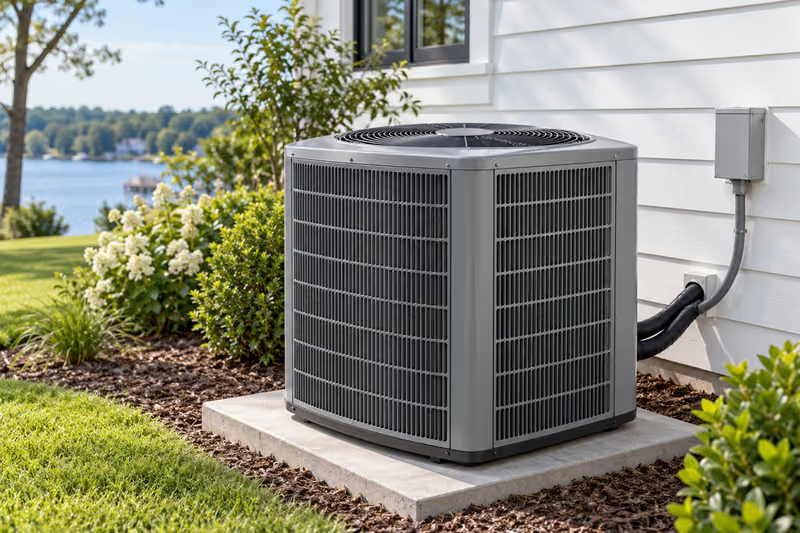
Efficiency ratings tell you two things: how much electricity a system uses in a standard lab test, and what kind of compressor sits inside. When you compare quotes for an AC replacement or a new heat pump, you will see SEER2, EER2, HSPF2, and AFUE. Knowing what each measures helps you spend where you will notice the difference.
Why SEER became SEER2
For decades, the U.S. Department of Energy (DOE) rated central air conditioners and heat pumps using SEER (Seasonal Energy Efficiency Ratio), EER (Energy Efficiency Ratio), and HSPF (Heating Seasonal Performance Factor).
There was one catch with those original laboratory tests: they tested ducted equipment at an external static pressure of just 0.1 inches of water column (in. w.c.). Almost no real home has ductwork with resistance that low. Once a real filter, indoor coil, and supply register network are attached, most residential systems operate closer to 0.5 in. w.c. of static pressure.
On January 1, 2023, the DOE rolled out the M1 test procedure, which raised laboratory test static pressure fivefold—from 0.1 to 0.5 in. w.c. for ducted split systems. That change created the new ratings you see on yellow EnergyGuide stickers today:
- SEER2 (Seasonal Energy Efficiency Ratio 2)
- EER2 (Energy Efficiency Ratio 2)
- HSPF2 (Heating Seasonal Performance Factor 2)
Because the indoor blower motor uses more wattage pushing air against realistic duct pressure during the M1 test, a system’s SEER2 number is roughly 4.5% to 5% lower than its old SEER number, and its HSPF2 number is roughly 15% lower than its old HSPF number—even when the physical machine hasn’t changed a single screw.
What each efficiency rating measures
1. SEER2: Seasonal cooling efficiency
Think of SEER2 like highway-and-city combined miles per gallon for summer cooling. It divides the total cooling output (in BTUs) across an entire cooling season by the total watt-hours of electricity consumed.
Crucially, the SEER2 test assumes outdoor temperatures vary between 65°F and 104°F, with the vast majority of test hours weighted toward mild and warm weather (75°F to 85°F) rather than scorching 100°F afternoons. That is why two-stage and variable-speed systems score so high on SEER2: they spend most of the summer cruising gently at half speed.
2. EER2: Peak-heat cooling efficiency
While SEER2 measures a whole season of mixed weather, EER2 measures how efficiently an air conditioner or heat pump performs at a single, brutal snapshot: 95°F outdoor temperature, 80°F indoor return air, and 50% relative humidity with the compressor running at full capacity.
Why should you care about EER2?
- If you live in the Southwest (Arizona, southern California, Nevada), federal regulations require both a minimum SEER2 and a minimum EER2 rating because peak afternoon demand strains the desert power grid.
- Many local electric utilities base their equipment rebate tiers on meeting both a SEER2 and an EER2 threshold.
3. HSPF2: Winter heat pump heating efficiency
If you are installing a heat pump or ductless mini-split, you also need to check HSPF2. It measures total space heating output (in BTUs) divided by total electricity consumed (in watt-hours)—including any backup electric resistance heat strips—across a standard winter season.
4. AFUE: Gas furnace fuel efficiency
Gas furnaces don’t use SEER2 or HSPF2. Instead, they carry an AFUE (Annual Fuel Utilization Efficiency) percentage, such as 80% AFUE or 96% AFUE. Compare gas and electric heating metrics side by side in our guide to heat pumps vs. furnaces.
Federal regional minimum standards
Since January 1, 2023, the Department of Energy has enforced different baseline efficiency rules across three U.S. climate regions: North, Southeast, and Southwest.
| Equipment Type & Region | Minimum SEER2 | Minimum EER2 / HSPF2 | Enforcement Rule |
|---|---|---|---|
| Central AC — North | 13.4 SEER2 | — | Based on date of manufacture |
| Central AC — Southeast (< 45k BTU) | 14.3 SEER2 (13.8 SEER2 if ≥ 45k BTU) | — | Based on date of installation |
| Central AC — Southwest (< 45k BTU) | 14.3 SEER2 (13.8 SEER2 if ≥ 45k BTU) | 11.7 EER2 (11.2 EER2 if ≥ 45k BTU) | Based on date of installation |
| Split Heat Pump — Nationwide | 14.3 SEER2 | 7.5 HSPF2 | Based on date of manufacture |
Note: Southeast and Southwest rules apply to where the equipment is installed, meaning a contractor cannot legally install a 13.4 SEER2 northern condenser in North Carolina, Texas, or Arizona.
Why compressor staging matters more than the raw number
Homeowners often ask whether jumping from 14.3 SEER2 to 16 SEER2 is worth the cost. The answer has less to do with the 1.7-point difference on the sticker and everything to do with how the compressor operates.
Single-stage systems (Typically 13.4 to 15.2 SEER2)
A single-stage air conditioner only has two states: 100% on and 100% off. It is sized to keep your house cool on the hottest afternoon of the summer. That means on an 82°F June day, it has far more cooling power than your house needs. It blasts cold air for eight minutes, satisfies the thermostat, and shuts off before pulling much humidity out of the air.
Two-stage systems (Typically 15.2 to 17.5 SEER2)
A two-stage compressor has a low gear (around 65–70% capacity) and a high gear (100% capacity). Roughly 80% of the summer, it runs quietly in low gear. Because the air stays moving over the cold indoor evaporator coil for longer stretches, the coil wrings out noticeably more indoor moisture and keeps upstairs and downstairs temperatures much closer together.
Variable-speed inverter systems (Typically 17.5 to 22+ SEER2)
Instead of stepping between one or two fixed speeds, an inverter-driven variable-speed compressor adjusts its speed continuously—often from 25% or 30% up to 100% in tiny increments. Once your home reaches 72°F, the system simply throttles back to match the exact heat entering through your roof and windows.
The benefits you feel every day are:
- Rock-steady temperatures within half a degree of your setting
- Superior summer humidity control without overcooling the house
- Soft, quiet startups outside your bedroom window instead of loud compressor clunks
Why you only get the rated SEER2 with a matched coil and blower
Here is something few sales brochures mention: an outdoor condenser does not have a SEER2 rating by itself.
Every official efficiency rating is certified by the AHRI (Air-Conditioning, Heating, and Refrigeration Institute) for a specific combination of:
- The outdoor condenser or heat pump
- The indoor evaporator coil
- The indoor furnace or air handler blower motor
If you attach a brand-new 16 SEER2 outdoor unit to an old indoor coil and a fifteen-year-old single-speed furnace blower, you will not get 16 SEER2 performance—and you will not have an AHRI certificate to qualify for local utility rebates.
Even worse, high static pressure from undersized ductwork or a dirty 1-inch filter forces the blower to burn extra watts and reduces airflow across the coil. That is why static pressure checks, matched indoor and outdoor components, and a real load calculation matter (see what size HVAC system you need).
Which SEER2 tier makes sense for your home?
You don’t need to buy the highest SEER2 number on the market to get a great system. Here is a practical way to choose:
- Choose the Baseline / Good Tier (13.4–14.3 SEER2 single-stage) if you have a tight budget, live in a mild climate with a short cooling season, or plan to sell the home within a few years.
- Choose the Mid / Better Tier (15.2–17 SEER2 two-stage) if you plan to stay in your home five or more years, live in a two-story house, or want noticeably quieter cooling and better summer dehumidification without paying top-shelf prices.
- Choose the Premium / Best Tier (18+ SEER2 variable-speed inverter) if you live in a hot or humid climate (like Texas, Georgia, the Carolinas, or Arizona), struggle with hot upstairs bedrooms, want near-silent outdoor operation, or need strong winter heating from a cold-climate heat pump.
Also keep in mind that while the federal Section 25C tax credit ended for systems placed in service after December 31, 2025, many local electric utilities offer cash rebates for systems that hit specific SEER2, EER2, and HSPF2 tiers. See how equipment tiers affect your total project budget in our HVAC replacement cost guide.