Hot water for your household.
Replace your water heater with a tank, tankless, or hybrid heat pump model.
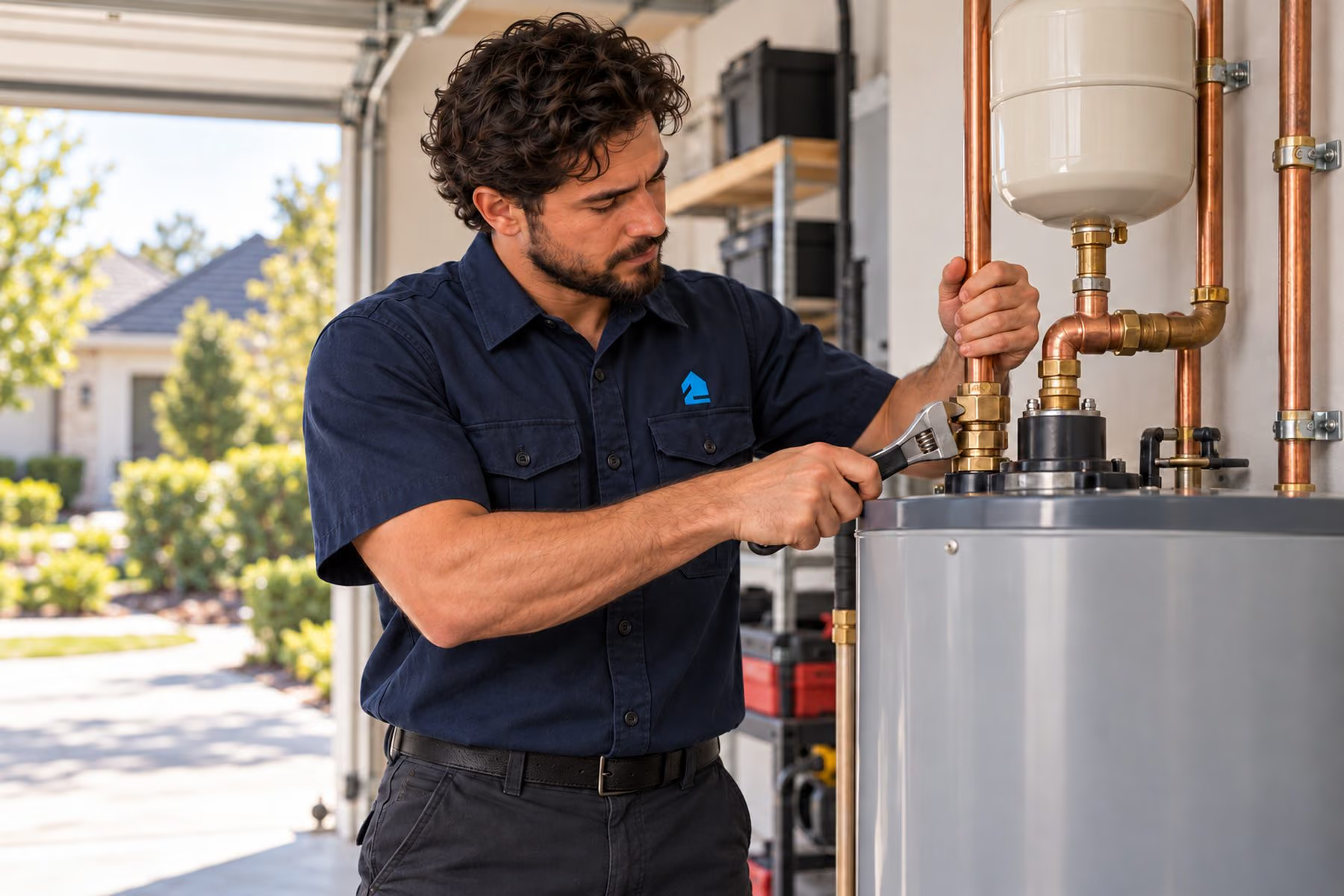
Installs are performed by licensed partner crews in Etho uniform.
What’s included.
- Household needs and utility assessment
- Equipment sized for your home
- Licensed installation and old-unit removal
- Leak testing and permit coordination
Compare your options.
| Tier | Water heater type | How it heats water | Best for |
|---|---|---|---|
| Good | High-recovery gas or electric storage tank | Insulated 40-, 50-, or 75-gallon tank with gas burner or dual electric elements | Straightforward, fast like-for-like replacements with the lowest installation cost |
| Better | Hybrid heat pump water heater (electric) | Uses an integrated heat pump on top of the tank to pull warmth from ambient air, with electric backup elements | Garages, basements, and homeowners replacing standard electric tanks to cut monthly power bills |
| Best | Condensing gas tankless | Superheats water on demand through dual heat exchangers as soon as you open a hot faucet | Families wanting continuous hot water, compact wall-mounted footprint, and long equipment life |
Your price depends on the equipment, your home, and installation needs. See financing.
Questions about water heaters.
How does a hybrid heat pump water heater work?
A hybrid heat pump water heater combines a well-insulated storage tank with a compact heat pump mounted on top. Instead of relying solely on electric resistance elements, it absorbs heat from the surrounding air (and dehumidifies your basement or garage as a bonus) to heat the water much more efficiently.
Can I bundle a water heater replacement with my furnace or heat pump installation?
Yes. Because your water heater and furnace often share the same utility room, gas supply line, flue chimney, and condensate drain, replacing an aging water heater while a crew is already on site can avoid a separate trip.
Why would switching my furnace to a heat pump or 96% condensing furnace affect my old gas water heater?
Older 80% gas furnaces and atmospheric gas water heaters often share a single metal flue chimney. When you remove the 80% furnace, the remaining chimney can become too wide for the small water heater to draft safely on its own (an "orphaned water heater"), which can require a chimney liner or upgrading the water heater.
Is a tankless water heater worth the upgrade over a standard tank?
Condensing gas tankless models free up floor space, last longer when descaled regularly, and deliver continuous hot water. However, upgrading from a standard tank to tankless usually requires new PVC vent pipes, a 120V outlet, a condensate neutralizer, and sometimes a larger gas line—items your written quote lists.
What is Uniform Energy Factor (UEF)?
UEF is the federal Department of Energy metric that measures how efficiently a water heater converts energy into hot water based on realistic draw patterns. A standard electric tank typically scores around 0.92–0.95 UEF, whereas a hybrid heat pump water heater can reach 3.3 to 4.0+ UEF.
Sizing and efficiency.
Sizing and efficiency.
Replace before an emergency leak
If your tank water heater sits in the same utility closet or garage as your furnace, replacing it proactively alongside your HVAC avoids water damage and saves a second crew trip.
Hybrid heat pump efficiency
Heat pump water heaters pull warmth from the surrounding garage or basement air to heat water using a fraction of the electricity of a standard electric tank.
Tankless options
Condensing gas tankless water heaters heat water on demand so hot water lasts through back-to-back showers.
Installed to code
Code may call for a new temperature-and-pressure relief valve, an expansion tank, a drain pan, or seismic strapping. Your written scope lists what your home needs.
Why homeowners pair water heater and HVAC upgrades
Walk into almost any basement, garage, or utility closet and you will see the water heater sitting right beside the furnace or air handler. Often both units were installed the year the house was built—or replaced during the same remodel a decade ago.
Even though a water heater is a standalone appliance, it is closely tied to your HVAC system’s mechanical infrastructure. Gas water heaters share the same gas meter and frequently share a metal flue chimney with an 80% furnace. Hybrid heat pump water heaters interact with the temperature and humidity of the room around them.
You can replace a failing water heater on its own or bundle it as a smart add-on alongside a furnace replacement, heat pump, or AC replacement.
Good, better, and best water heater options
Water heating is typically the second-largest energy expense in an American home, right behind space heating and cooling. We offer three distinct technologies depending on your fuel source, space, and efficiency goals:
Understanding UEF and orphan flues
Water heater efficiency is measured by UEF (Uniform Energy Factor). The higher the UEF, the less energy it takes to deliver your daily hot water. Hybrid heat pump water heaters achieve remarkably high UEF numbers (often above 3.3 UEF) for the exact same reason heat pumps excel at heating homes: moving heat is three to four times more efficient than generating it with electric resistance coils.
If you are upgrading an 80% gas furnace to an all-electric heat pump or a 96%+ condensing furnace (see heat pump vs. furnace), check whether your existing atmospheric gas water heater will become an orphaned water heater on an oversized chimney flue. Catching that early helps prevent carbon monoxide backdrafting and helps your project pass code inspection.
Sizing for peak morning demand
Tank water heaters aren’t sized solely by how many gallons the cylinder holds. The number that matters most is the First-Hour Rating (FHR)—how many gallons of hot water the heater can supply in a busy 60-minute window starting with a full tank.
For tankless systems, sizing is based on gallons per minute (GPM) at your local winter groundwater temperature rise. Heating 40°F January groundwater in Chicago or Albany up to 120°F requires much more BTU capacity per gallon than heating 65°F groundwater in Phoenix or Houston. A water heater is sized around your bathroom count, fixture flow rates, and regional incoming water temperature.
What affects the price of a water heater replacement
Your total installed price depends on whether you are doing a like-for-like swap or upgrading technologies:
- Like-for-like tank vs. technology conversion: Swapping a 50-gallon gas tank for a new 50-gallon gas tank uses the existing footprint and connections. Converting to a condensing tankless unit requires running PVC intake/exhaust venting, adding a condensate neutralizer, and confirming gas line BTU capacity.
- Electrical and space requirements for heat pump tanks: Hybrid heat pump water heaters need sufficient surrounding room air volume (or ducting kits) and typically run on a 30-amp 240V circuit (though plug-in 120V models exist for certain gas-to-electric retrofits).
- Plumbing code updates: Local building codes often require adding a thermal expansion tank on closed water systems, an aluminium drain pan piped to a safe drain, a full-port ball valve, or seismic earthquake strapping (required in California and Utah markets).
- Local utility rebates: While the federal Section 25C tax credit expired for equipment placed in service after December 31, 2025, many electric and gas utilities offer generous rebates for ENERGY STAR hybrid heat pump and condensing tankless water heaters. See our HVAC replacement cost guide for more on incentives.
Find the right water heater for your home.
Your advisor confirms the equipment, scope, and price with you.