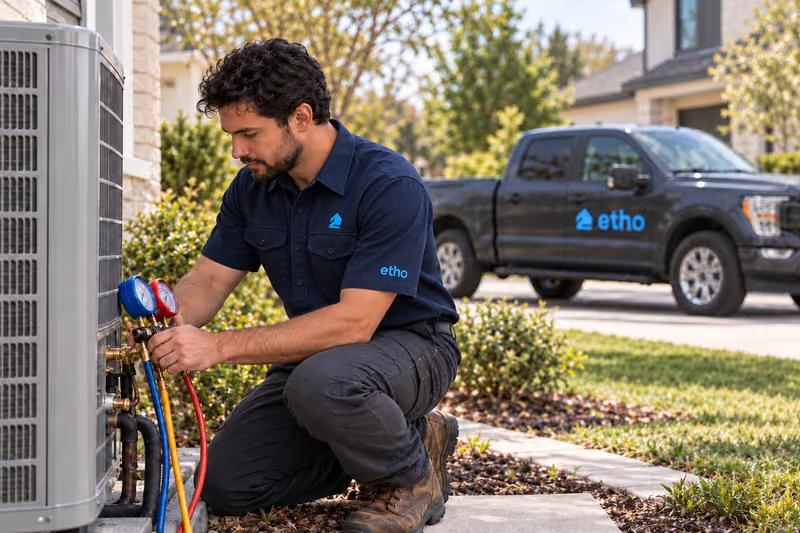
New central air conditioners, heat pumps, and ductless mini-splits are moving from R-410A to R-454B and R-32. You can still repair a working R-410A system, but a new outdoor unit needs a matching indoor coil. Below: why the change happened, how the new refrigerants work, and what it means for your home.
Why did the refrigerant change happen?
Every air conditioner and heat pump circulates a chemical refrigerant inside a closed copper loop to absorb heat indoors and release it outdoors. Over the past thirty years, residential HVAC has gone through two major refrigerant transitions:
- R-22 (Freon) to R-410A (Puron): Older R-22 was a hydrochlorofluorocarbon (HCFC) that depleted the Earth’s ozone layer. Beginning in 2010 and concluding with a complete production ban in 2020, the industry phased out R-22 in favor of ozone-friendly R-410A.
- R-410A to R-454B and R-32: While R-410A doesn’t harm the ozone layer, it is a hydrofluorocarbon (HFC) with a high Global Warming Potential (GWP) of 2,088—meaning one pound of leaked R-410A traps about 2,088 times as much atmospheric heat over a 100-year period as one pound of carbon dioxide.
In late 2020, Congress passed the bipartisan American Innovation and Manufacturing (AIM) Act, directing the U.S. Environmental Protection Agency (EPA) to phase down HFC production and consumption by 85% through 2036. Under the EPA’s Technology Transitions rule, newly manufactured residential central air conditioners and heat pumps transitioned starting January 1, 2025, to refrigerants with a GWP below 700 (with an EPA installation grace period until January 1, 2026, for pre-2025 R-410A split-system inventory).
Meet the new refrigerants: R-454B vs. R-32
Because no single chemical was mandated by the government—only the 700 GWP ceiling—equipment manufacturers settled on two primary next-generation refrigerants for residential systems:
| Metric | R-410A (Legacy) | R-454B (Next-Gen Blend) | R-32 (Next-Gen Pure HFC) |
|---|---|---|---|
| Global Warming Potential (GWP) | ~2,088 | ~466 (78% lower than R-410A) | ~675 (68% lower than R-410A) |
| Ozone Depletion Potential | Zero | Zero | Zero |
| ASHRAE Safety Classification | A1 (Non-toxic, non-flammable) | A2L (Lower toxicity, mildly flammable) | A2L (Lower toxicity, mildly flammable) |
| Composition | Blend (50% R-32 / 50% R-125) | Blend (68.9% R-32 / 31.1% R-1234yf) | Single-component refrigerant (100% R-32) |
Should you worry about whether a brand uses R-454B or R-32?
For a homeowner, both refrigerants are proven, efficient, and widely supported by major manufacturers and supply houses.
- R-454B closely mimics the operating pressures and thermal properties of R-410A while cutting GWP by roughly 78%, which is why the majority of North American ducted HVAC manufacturers selected it as their primary replacement.
- R-32 has been used in tens of millions of residential ductless and ducted systems across Europe, Asia, and Australia for over a decade, and is actually half of the recipe of R-410A.
Both deliver slightly better heat-transfer efficiency than R-410A, helping systems reach today’s SEER2 and HSPF2 ratings.
What does “A2L” mean for safety inside your home?
The biggest technical difference with R-454B and R-32 is their ASHRAE A2L safety classification:
- “A” means lower toxicity (the same as R-410A).
- “2L” means lower flammability—as distinct from Class 2 (flammable) or Class 3 (highly flammable, like propane).
To ignite an A2L refrigerant, it has to collect in a high concentration in an enclosed space and meet an open flame or high-energy heat source; even then, its flame propagation speed is extremely slow. Most homeowners don’t realize that millions of newer kitchen refrigerators already use a small charge of Class A3 refrigerant, and newer cars have used an A2L refrigerant (R-1234yf) in dashboard air conditioners for over a decade.
Still, residential HVAC codes and UL safety standards (UL 60335-2-40) leave nothing to chance. Every new ducted R-454B or R-32 indoor coil or air handler includes a Refrigerant Detection System (RDS):
- Built-in leak sensor: An electronic sensor mounted right inside the indoor evaporator coil cabinet monitors the air around the coil 24/7.
- Automatic mitigation: In the rare event the sensor detects refrigerant leaking from the coil, it automatically shuts off the outdoor compressor (and any furnace ignition or electric heat strips) and turns on the indoor blower fan.
- Rapid dilution: The blower circulates air through your ductwork, dispersing any leaked refrigerant smoothly across the volume of your home so it can never pool inside the utility closet.
What the refrigerant transition means when your AC breaks
If your current R-410A or R-22 system is aging or acting up (see signs you need a new AC), here is how the new rules affect your repair-versus-replace decision:
1. You can still repair an existing R-410A system
Nobody is outlawing your current air conditioner. While virgin HFC production steps down over time under the AIM Act, both new and reclaimed R-410A remain legal and available to service existing units for years to come. If your seven-year-old R-410A system just needs a capacitor, contactor, or minor repair, fix it and keep running it.
2. You cannot mix an R-454B/R-32 outdoor unit with an old R-410A indoor coil
In the past, when an outdoor condenser failed out of warranty, some budget contractors offered to swap only the outdoor box while leaving the old indoor coil in place.
With the move to R-454B and R-32, you must replace both the outdoor unit and the indoor evaporator coil together:
- Old R-410A coils lack the required UL-listed A2L leak detection sensor and mitigation board.
- The thermal expansion valve (TXV) or metering device must be calibrated for the new refrigerant.
- Mixing refrigerants or mismatched coils voids manufacturer warranties and violates safety listings.
3. Can existing copper refrigerant lines be reused?
In most replacements where the existing copper line set is the proper diameter, intact, and accessible for pressure testing, a licensed installer can often flush the lines clean of old oil, braze while flowing dry nitrogen, pressure-test at high PSI, and pull a deep vacuum below 500 microns. If the existing line set is kinked, corroded, or undersized, replacing the copper line set is the right call.
Ask about A2L handling
A2L systems call for the manufacturer’s handling and commissioning steps. Ask your advisor how your crew will handle them.